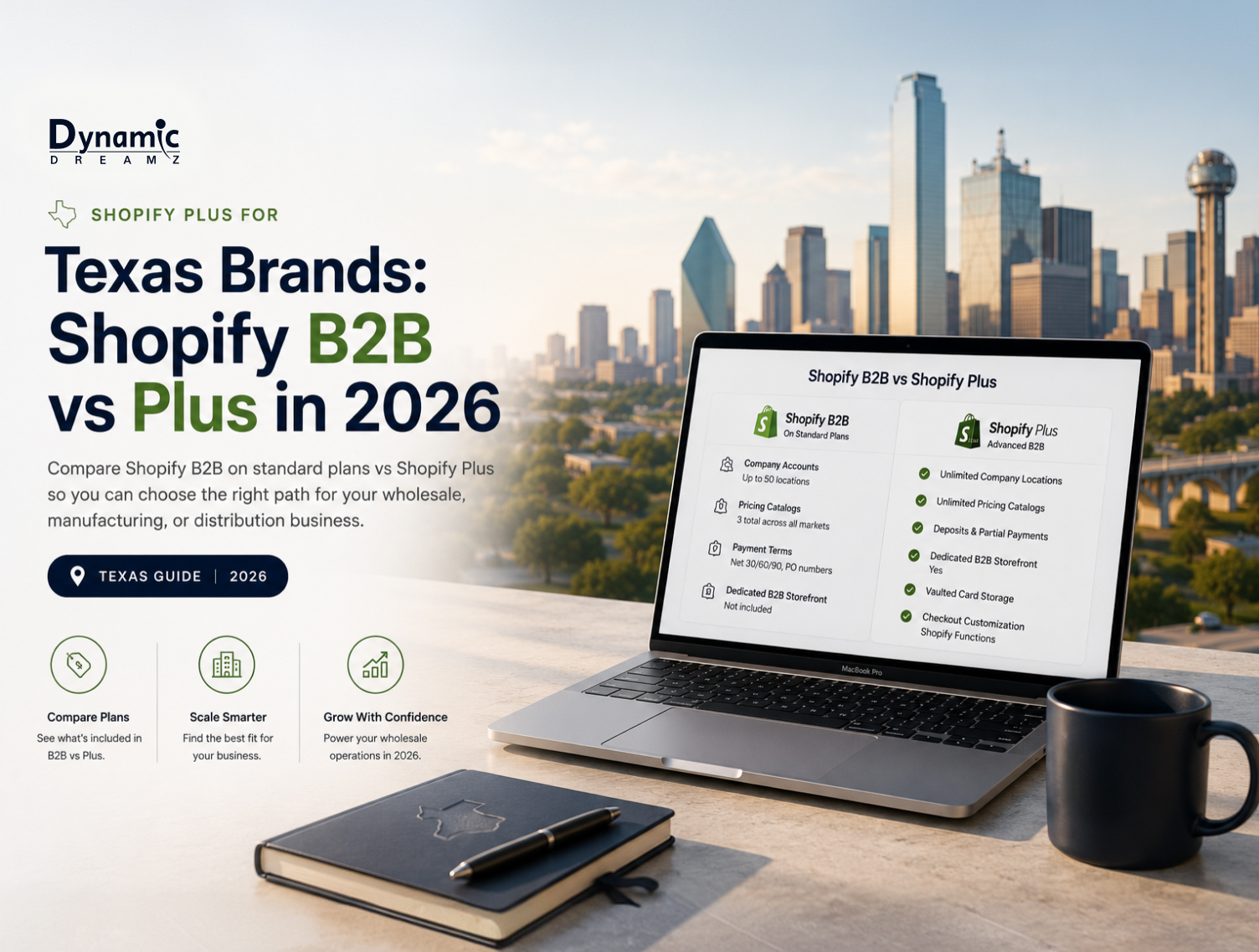
Shopify Plus for Texas brands running B2B or wholesale is no longer an automatic requirement the way it was before April 2026. As of that update, core B2B features, company accounts, custom pricing, and net payment terms now work on every paid Shopify plan. Plus is still the right call for high-volume wholesale operations, but the decision now comes down to a specific list of capabilities rather than B2B access itself.
Why Shopify Plus for Texas Brands Looks Different After April 2026
For years, the Shopify wholesale conversation started and ended with one fact: if you wanted company accounts, custom pricing catalogs, or net terms, you needed Shopify Plus. That changed on April 2, 2026, when Shopify rolled foundational B2B features out to Basic, Grow, and Advanced plans.
For Texas brands in manufacturing, distribution, and wholesale, an industry mix that runs deep across Houston, Dallas, and San Antonio, this single update materially lowered the cost of entry into B2B ecommerce on Shopify and changed what “needing Shopify Plus” actually means.
Shopify B2B vs Shopify Plus: What Texas Brands Get Without Upgrading
Here’s what every paid plan now includes, no Plus subscription required:
| Feature | Standard plans (Basic/Grow/Advanced) | Shopify Plus |
| Company accounts | Up to 50 locations per company | Unlimited |
| Pricing catalogs | 3 total, across all markets combined | Unlimited |
| Payment terms | Net 30/60/90, PO number | Same, plus deposits & partial payments |
| Dedicated B2B storefront (own domain) | No | Yes |
| Vaulted card storage for buyers | No | Yes |
| Checkout customization (Shopify Functions) | No | Yes |
| Shopify Flow automations | Included | Included |
For a wholesale operation running a handful of pricing tiers and straightforward net terms, the standard plan feature set genuinely covers most of what’s needed.
What Still Requires Shopify Plus for Texas Brands
The gap between plans narrowed in April 2026, but it didn’t close. What still requires Plus is a specific, advanced set of capabilities: unlimited pricing catalogs, a fully separate B2B storefront on its own domain, vaulted credit card storage for repeat buyers, deposit and partial payment workflows, and custom checkout logic through Shopify Functions.
None of these are minor conveniences; for a distributor managing dozens of accounts with individually negotiated pricing, or a manufacturer needing a separate branded buyer portal, these are operational requirements, not nice-to-haves.
The Catalog Cap Most Texas Wholesalers Don’t See Coming
This is the detail that catches a lot of growing wholesale operations off guard: the three-catalog limit on standard plans applies across all of your B2B markets combined, not per market. A distributor running separate pricing for, say, three regional buyer tiers, hits that cap instantly, with no room left for a fourth without upgrading.
If your wholesale pricing structure is more complex than a single flat tier, it’s worth mapping out your actual catalog count before assuming a standard plan will hold up.
Shopify Plus Pricing for Texas Brands in 2026
Shopify Plus itself runs from $2,300 per month, scaling with sales volume and additional services. On top of the subscription, adding native B2B functionality alongside an existing DTC store, company account configuration, wholesale application forms, pricing tier setup, and approval workflows typically runs $15,000 to $50,000 in development cost, depending on how customized the buyer experience needs to be.
For a Texas brand evaluating the upgrade, the math usually comes down to whether the catalog, storefront, and payment features Plus unlocks will recover that cost faster than staying on a standard plan with workarounds.
Shopify Wholesale Texas: Why This Matters More Here
Texas carries a heavier B2B and wholesale footprint than most of the other markets we work in. Between Houston’s energy and industrial base, Dallas’s logistics and distribution hub, and a steady manufacturing presence across San Antonio and the broader state, a meaningfully higher share of Texas Shopify projects involve a wholesale or B2B component from day one, not as an add-on years later.
That makes the B2B vs Plus decision a front-loaded one for a lot of Texas brands, rather than something to revisit after they’ve already scaled on a DTC-only setup.
Enterprise Shopify Development in Texas: When to Bring in a Partner
Getting B2B architecture right the first time matters more than it might seem, since restructuring catalogs, company accounts, or payment workflows after launch is considerably more disruptive than planning for them upfront.
Dynamic Dreamz works with Texas manufacturers, distributors, and wholesale brands on exactly this kind of B2B build, whether that means a standard-plan setup done right or a full Shopify Plus implementation, as a Shopify Premier Partner with the technical depth for ERP integrations and custom checkout work.
If your business is evaluating this for a Texas-based Shopify project, it’s worth mapping your actual catalog and account requirements before deciding which plan tier fits.
FAQ
Do you still need Shopify Plus for B2B after the April 2026 update?
Yes. There’s no additional fee; it’s included for eligible merchants on a paid Shopify plan. You only pay your supplier’s wholesale price for products you import.
What’s the real difference between Shopify B2B and Shopify Plus B2B?
Standard plans cap you at 3 pricing catalogs across all markets and don’t include a separate B2B storefront, vaulted card storage, or deposit/partial payment options. Plus removes the catalog cap and adds all of those advanced capabilities.
What does Shopify Plus B2B cost compared to standard B2B?
Shopify Plus starts at $2,300/month, with B2B development work to configure it properly typically adding $15,000 to $50,000, compared to standard plans where B2B features are included in the existing subscription cost.
Can Texas wholesale and distribution brands run B2B without upgrading to Plus?
Yes, for operations with straightforward pricing tiers and standard net terms. Brands with more complex catalog structures, multiple negotiated pricing tiers, or a need for a dedicated buyer-facing storefront will likely hit the standard plan’s limits faster.