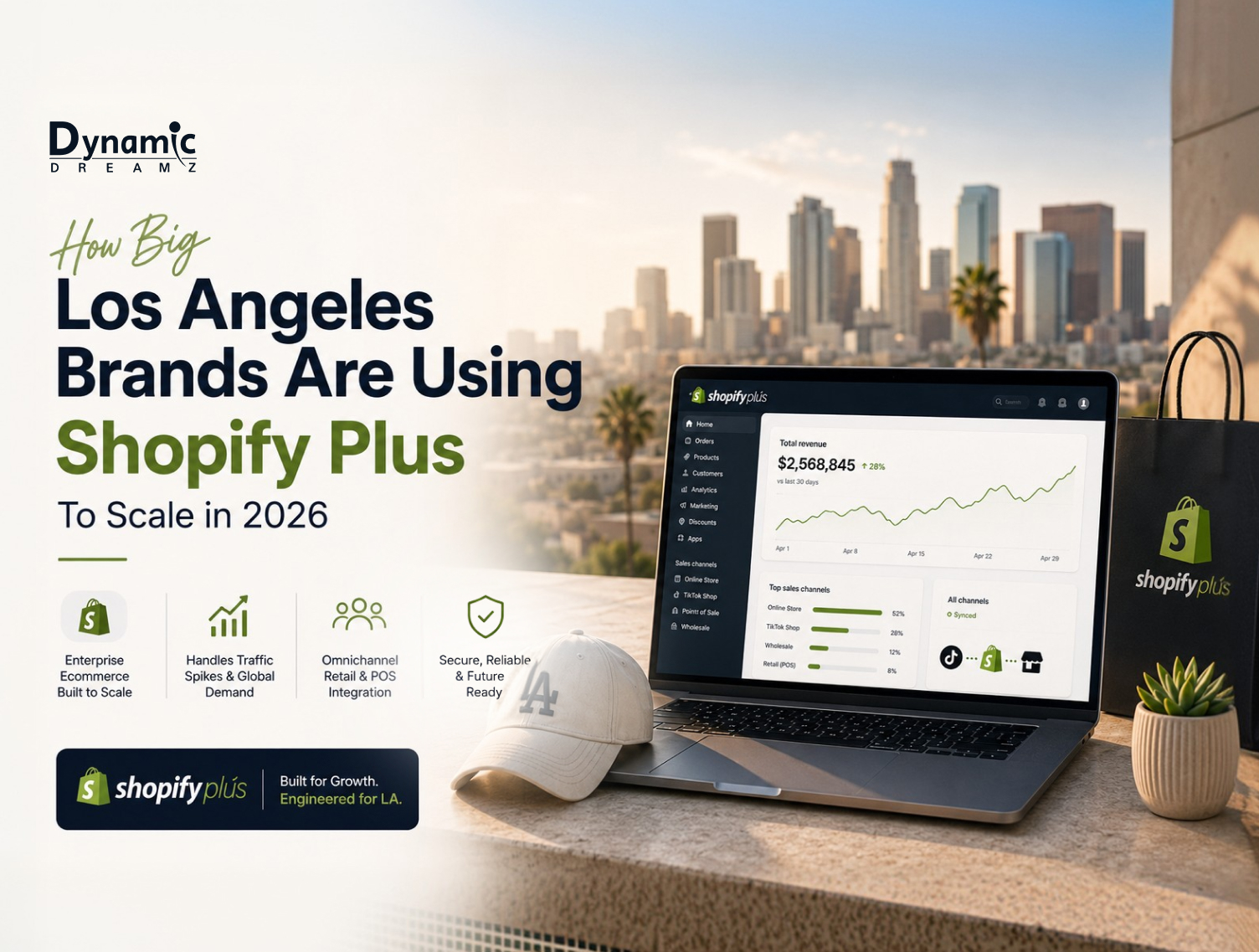
Los Angeles Brands doing business in beauty, fashion, and wellness these days are tilting more and more towards Shopify Plus. And no, it’s not random, the reason is simply that they have already outgrown the service of standard Shopify plan.
They’re getting high-volume traffic now, especially from viral TikTok moments, multi-location retail expansion, subscription billing at scale, and checkout customization that off-the-shelf themes can’t support.
Because of these reasons, the Los Angeles Market, which is also known as the country’s direct-to-consumer capital, is choosing Shopify Plus. And today we are gonna talk about it, so we can understand how Shopify Plus is becoming the default infrastructure for brands that want to move from simply “fast-growing startup” to “established retail name.”
Why Shopify Plus Is a Hotspot for Los Angeles Brands?
Few cities pack as much DTC density into one metro area as LA. Between the beauty and wellness brands clustered around Venice and Santa Monica, the fashion labels based downtown and in the Arts District, and the steady flow of product launching through influencer and TikTok-first marketing, Los Angeles brands tend to hit Shopify’s growth ceilings faster than brands elsewhere.
Three forces are driving that shift in 2026, specifically:
- Social-first launches. A single TikTok moment can send order volume up tenfold overnight. Standard Shopify plans aren’t built to absorb that kind of spike without checkout errors or app slowdowns.
- Retail re-entry. A wave of brands that started online-only are opening physical storefronts and pop-ups across LA, which means inventory, POS, and ecommerce systems all need to talk to each other in real time.
- Subscription-driven growth. Beauty and wellness brands in particular are tilting more and more towards recurring revenue, and that basically require much more flexible billing logic than basic Shopify subscription apps typically offer.
Shopify Plus Scaling Ecommerce: When the Upgrade Actually Makes Sense
Not every growing brand needs Shopify Plus, and jumping too early is a common, costly mistake. The upgrade tends to make financial sense once a brand is consistently processing high six-figure to seven-figure annual revenue, running multiple sales channels at once, or hitting performance and checkout limitations on standard plans.
The practical differences that matter most for scaling brands:
- Checkout customization. Plus unlocks checkout.liquid (or Checkout Extensibility on newer setups), letting brands add upsells, custom shipping logic, or loyalty integrations directly inside checkout, something standard Shopify simply doesn’t allow.
- Higher API and bandwidth limits. Brands running flash sales or influencer drops need infrastructure that won’t buckle under sudden traffic.
- Multi-store and wholesale support. Plus brands can run separate storefronts for DTC, wholesale, and international markets from one back end.
- Dedicated automation tooling. Shopify Flow and Launchpad let operations teams automate inventory, fulfillment, and promotional logic without custom development for every change.
Cost is the question most LA brands ask first, and reasonably so: Shopify Plus runs on a revenue-share or flat enterprise pricing model that’s substantially higher than standard plans, which is exactly why the upgrade should be tied to a clear growth trigger rather than ambition alone.
TikTok Shop Shopify Plus Integration: Where Social Commerce Meets Infrastructure
For LA brands, social commerce isn’t just a side channel anymore; but on frequent times, it’s the primary acquisition engine. Shopify Plus brands are connecting TikTok Shop directly into their existing inventory and fulfillment systems. Through which a sale can be made, through a livestream or a creator’s video updates stock levels & triggers fulfillment exactly the way a sale through the main storefront would.
What this actually requires technically: real-time inventory sync across every channel a brand sells through, webhook-based order routing so TikTok Shop orders land in the same fulfillment queue as direct site orders, and enough backend capacity to handle the order bursts that come from a single viral post.
This is one of the clearest cases where Shopify Plus’s higher infrastructure ceiling pays for itself. A brand on a standard plan that goes viral on TikTok without this kind of integration in place is far more likely to oversell inventory or miss orders entirely.
Shopify POS Omnichannel Los Angeles: Bridging Digital and Physical Retail
LA’s retail culture tends to reward those brands that can easily show up in person pop-ups in Melrose, concept stores in Venice, and wholesale placement in boutiques across the city. Shopify POS, available as part of the Plus ecosystem, lets digitally native brands extend into physical retail without managing two disconnected systems.
The brands doing this well are using Shopify POS to keep a single source of truth for inventory across online and offline channels, let customers buy online and return or exchange in-store, and route loyalty and customer data through one CRM regardless of where the purchase happened.
For a brand built on social media virality, that consistency matters: a customer who discovers a product on TikTok and later walks into a pop-up expects the same experience and the same stock availability either way.
Shopify Plus Subscription Brands: Built for Recurring Revenue
Subscription models have become a core growth lever for LA’s beauty and wellness brands, and Shopify Plus gives them more room to build flexible billing logic than the subscription apps available on standard plans.
Brands are using this flexibility to offer pause-and-resume options without losing a subscriber, bundle one-time purchases with recurring orders in a single checkout, and adjust billing cycles dynamically based on customer behavior rather than a fixed app-imposed schedule.
The payoff shows up directly in customer lifetime value: brands that get subscription mechanics right typically see meaningfully lower churn than those running subscriptions through bolt-on apps with rigid logic.
What Enterprise Shopify Development in Los Angeles Actually Involves
Scaling on Shopify Plus isn’t a one-time build; rather, it’s an ongoing engineering relationship. So, the brands carrying the responsibility to handle work with a development partner on performance optimization, because as the catalogs and traffic keep growing, custom app and API integrations connecting ERPs, CRMs & fulfillment partners, checkout and post-purchase customization tied to specific conversion goals & continuous testing as Shopify itself rolls out platform changes.
This is also where choosing the right Shopify Plus partner in Los Angeles matters more than brands often expect going in. A generalist agency can launch a store; scaling one through traffic spikes, omnichannel expansion, and subscription complexity takes a team that’s done it before.
Dynamic Dreamz works with growing brands on exactly this kind of Shopify Plus scaling work, as a Shopify Premier Partner with experience across enterprise builds, custom integrations, and ongoing platform support, including for brands based in and selling into the Los Angeles market.
FAQ
When should a brand upgrade from regular Shopify to Shopify Plus?
Generally, once a brand is consistently hitting high six-figure to seven-figure annual revenue, running multiple sales channels, or running into checkout and API limitations that standard Shopify can’t resolve through apps alone.
What does Shopify Plus cost compared to standard Shopify?
Shopify Plus uses an enterprise pricing model, either a flat monthly fee or a revenue-share structure, that costs substantially more than standard Shopify plans, reflecting the added infrastructure, checkout customization, and support that come with it.
Can Shopify Plus handle TikTok Shop and social commerce at scale?
Yes. Shopify Plus’s higher API limits and infrastructure capacity are built to absorb the order spikes that come from viral social commerce moments, provided the inventory and fulfillment integrations are set up correctly beforehand.
How does Shopify POS help DTC brands move into physical retail?
It keeps inventory, customer data, and loyalty programs unified across online and in-person sales, so a brand expanding into pop-ups or retail locations doesn’t end up managing disconnected systems.
What’s the difference between a Shopify Plus Partner and a regular Shopify Partner?
A Shopify Plus Partner has been specifically vetted by Shopify to handle enterprise-level builds and complex migrations, while a standard Partner typically works on smaller, less technically demanding projects.