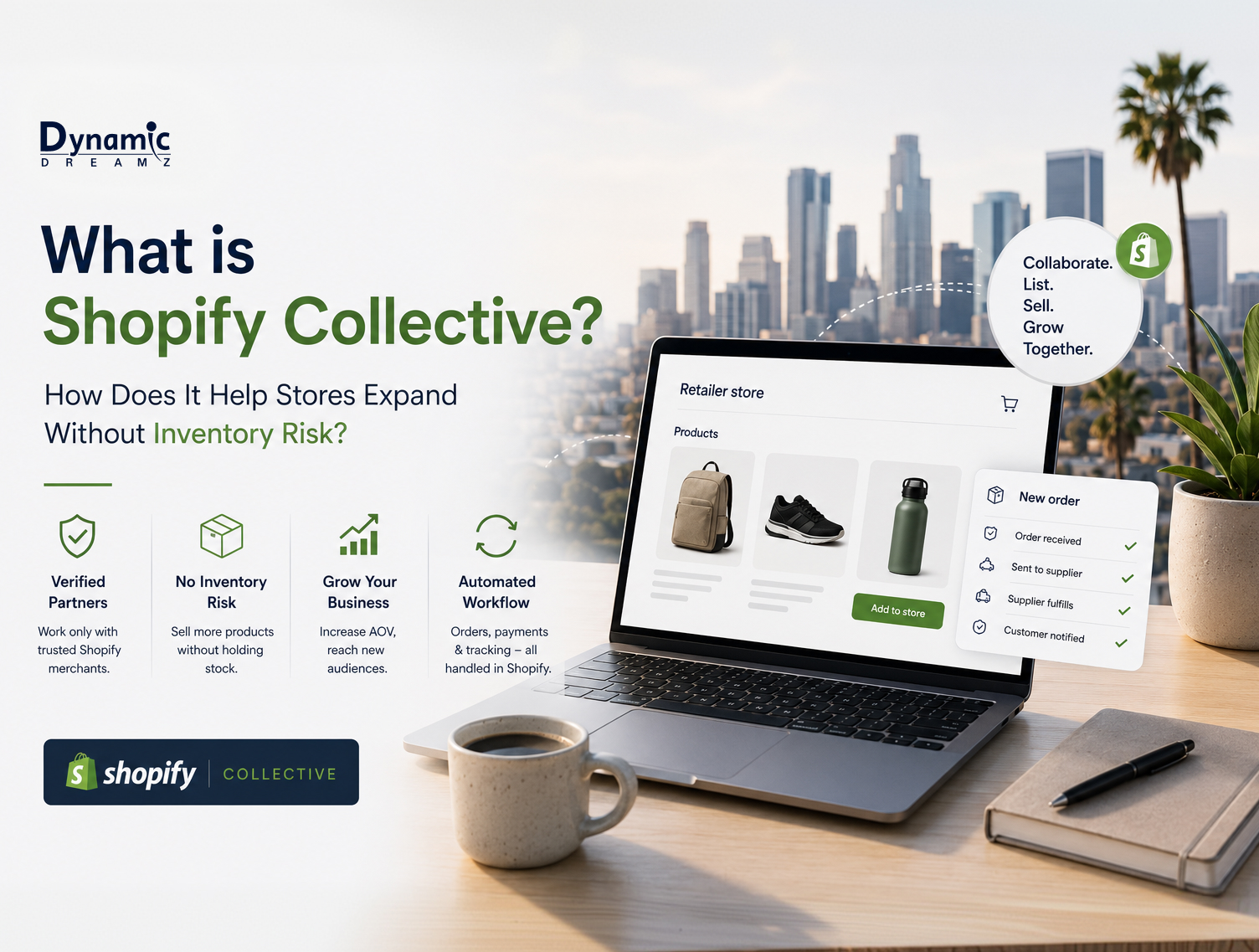
Till now, whenever you wanted to grow your product catalogue, you had to either increase the inventory, tie up more cash in stock, or be ready to face risk if those products didn’t sell. But Shopify Collective has flipped that equation.
Because it has come with a native Shopify feature, with the help of which stores can now easily sell each other’s products without either side touching extra inventory.
So, if you’re still wondering about whether or not it’s worth exploring for your store, then you should read this. Because here today, you are gonna learn all the basics about what Shopify Collective is, how it works, who it’s for, and where its limits are.
What Is Shopify Collective?
First of all, the Shopify Collective is a free, built-in feature that connects Shopify merchants, so they can seamlessly sell each other’s products from their very own storefronts. Here, one store will act as the retailer (the one listing & selling the product), while another one will act as the supplier (fulfilling the demand).
It’s different than the conventional dropshipping, where retailers often source from unknown overseas manufacturers; Shopify Collective only connects verified Shopify stores. That means:
- Retailers get access to vetted, brand-quality products instead of generic stock
- Suppliers get a built-in distribution channel without chasing wholesale deals manually
- Both sides operate inside the same Shopify admin, with synced inventory and automated payments
In short, it’s collaborative commerce, not dropshipping in the traditional sense, even though the mechanics feel similar.
How does Shopify Collective Work?
The workflow is the same whether you’re connecting with one partner or several. Here’s the step-by-step breakdown:
For Retailers:
- Apply through Shopify Admin- Shopify checks that your store meets eligibility requirements (more on that below).
- Discover or invite suppliers- Browse the Collective directory by category, or send a direct invite to a brand you already know.
- Import products- Pick items from a supplier’s price list and add them straight into your store, with images, descriptions, and pricing pulled in automatically.
- Set your retail price- You buy at the supplier’s wholesale rate and sell at your own retail price. The difference is your margin.
- Orders route automatically- When a customer buys, the order goes straight to the supplier for fulfilment. You never touch the product.
For Suppliers:
- Enable “discoverable” mode (optional) so retailers can find you, or wait for direct invitations.
- Set your wholesale price list for the products you want to share.
- Approve retailer partnerships and let them import your catalogue.
- Fulfil orders as they come in, packaging and shipping stay on your end, but the sale, payment split, and tracking sync are handled by Shopify.
Both sides can also operate as both retailer and supplier at the same time, which is one of the more underrated parts of how Shopify Collective works.
Shopify Collective Benefits
The appeal here isn’t just “more products.” It’s what that flexibility actually solves:
- Zero inventory risk-Retailers expand their catalogue without warehousing, prepaying for stock, or guessing demand.
- Faster catalogue growth- Adding a new product category takes hours, not months of supplier negotiation.
- New distribution for suppliers- Brands get listed across other Shopify stores’ audiences without building a sales team.
- Higher AOV potential- A wider product range gives customers more reasons to add to cart.
- Built-in trust layer- Every partner is a verified Shopify merchant, not an anonymous supplier from a marketplace directory.
- Operate as both- A single store can supply some products and retail others simultaneously, compounding the benefit.
A real example:fitness brand Ten Thousand partnered with GORUCK through Shopify Collective and saw a 16% increase in sales from new customers within the first week of the partnership going live without holding a single unit of GORUCK’s inventory.
Shopify Collective Eligibility
Not every store can join yet. To qualify, your store generally needs to:
- Be based in an eligible country (primarily the US and Canada, with availability expanding)
- Use Shopify Payments as your payment provider
- Be on a paid Shopify plan
- Have an active, operating store (no strict minimum sales threshold, but an established sales history makes approval smoother)
If you’re outside the currently supported regions, this is one to watch rather than act on immediately. Shopify has been expanding eligibility over time.
Is Shopify Collective Free?
Yes, Shopify Collective itself doesn’t carry a separate subscription fee. It’s included for eligible merchants on any paid Shopify plan. You’re not paying Shopify extra to use the feature; you’re simply paying your supplier’s wholesale price for the products you import, the same way you would in any wholesale relationship.
Shopify Collective vs. Traditional Dropshipping
This is where most stores get the decision wrong, so it’s worth being precise:
| Shopify Collective | Traditional Dropshipping | |
| Supplier vetting | Verified Shopify merchants only | Often unverified, overseas suppliers |
| Integration | Native, inside Shopify admin | Usually requires third-party apps |
| Product quality control | Higher established brands | Variable, harder to verify upfront |
| Shipping speed/reliability | Depends on the supplier, but generally more consistent | Often slower, less predictable |
| Pricing control | Pricing control Retailer sets retail price within supplier terms |
Retailers usually set prices freely |
| Messaging between partners | Limited, no built-in chat | Varies by platform/app |
Shopify Collective isn’t a replacement for dropshipping at scale; it’s a more controlled, brand-safe alternative for stores that want curated partnerships rather than a high-volume marketplace approach.
Shopify Collective Review: Where It Falls Short
To be fair to merchants actually considering this, here’s where Shopify Collective still has gaps:
- No SKU-level pricing control- Retailers can’t customise pricing at the variant level beyond what the supplier’s price list allows.
- No built-in messaging- Suppliers can’t notify retailers about stock or product changes inside the platform, and retailers can’t ask follow-up questions through Collective itself.
- API limitations- There’s no API support for sending or accepting invitations, so partnerships have to be set up manually through the Collective app.
- Webhook gaps at scale- Stores with high product volume may see incomplete variant data when handling large webhook batches.
- Overselling protection caveat- This only works with the standard checkout flow, not with manually created orders.
None of these are dealbreakers for most merchants, but they matter if you’re running high-SKU operations or need tighter partner communication.
Shopify Brand Collaboration: Who Should Actually Use This
Shopify Collective fits best when:
- You want to test a new product category before committing to inventory
- You have an engaged audience and want to cross-sell complementary (not competing) products
- You’re a supplier with strong product-market fit looking for new storefronts, not a new sales team
- You value brand-safe partnerships over volume-driven dropshipping
It fits less well if you need deep catalogue customisation, operate outside the US/Canada, or require direct in-platform communication with partners for fast-moving inventory changes.
How Dynamic Dreamz Can Help
Shopify Collective is simple in theory, but setting up retailer-supplier relationships, structuring your catalogue for partner sync, and handling the eligibility and storefront side correctly takes some Shopify expertise, especially if you’re running a custom theme or higher-volume catalogue.
As a Dynamic Dreamz client, you get that setup handled end-to-end: from eligibility checks and storefront integration to making sure your product data displays cleanly across every partner connection.
Final Thoughts
With Shopify Collective, merchants get to have a low-risk path to grow their catalogue or reach new customers, and that too without the help of traditional wholesale or dropshipping. And no, it’s not built for every business model, it’s for those stores who seeks curated, brand-safe partnerships, it’s one of the more practical tools Shopify has shipped in this space.
If you’re exploring whether Shopify Collective fits your store or need help setting up the storefront and catalogue side correctly, Dynamic Dreamz can help you get it right from day one.
FAQ
Is Shopify Collective free to use?
Yes. There’s no additional fee; it’s included for eligible merchants on a paid Shopify plan. You only pay your supplier’s wholesale price for products you import.
Who can use Shopify Collective?
As of now, eligible stores must be based in the US or Canada, because only then can they use Shopify Payments, and they must be on a paid Shopify plan.
Is Shopify Collective the same as dropshipping?
Not exactly, but we can say it’s quite similar: there would be no inventory or automated fulfilment, and every partner here would be a verified Shopify merchant, and that is quite different from typical dropshipping suppliers.
Can a store be both a retailer and a supplier?
Yes. Many stores use Shopify Collective in both roles at once, sourcing some products while supplying others.
What are the biggest limitations of Shopify Collective?
No SKU-level pricing control, no built-in partner messaging, and no API support for invitations are the most commonly cited gaps.