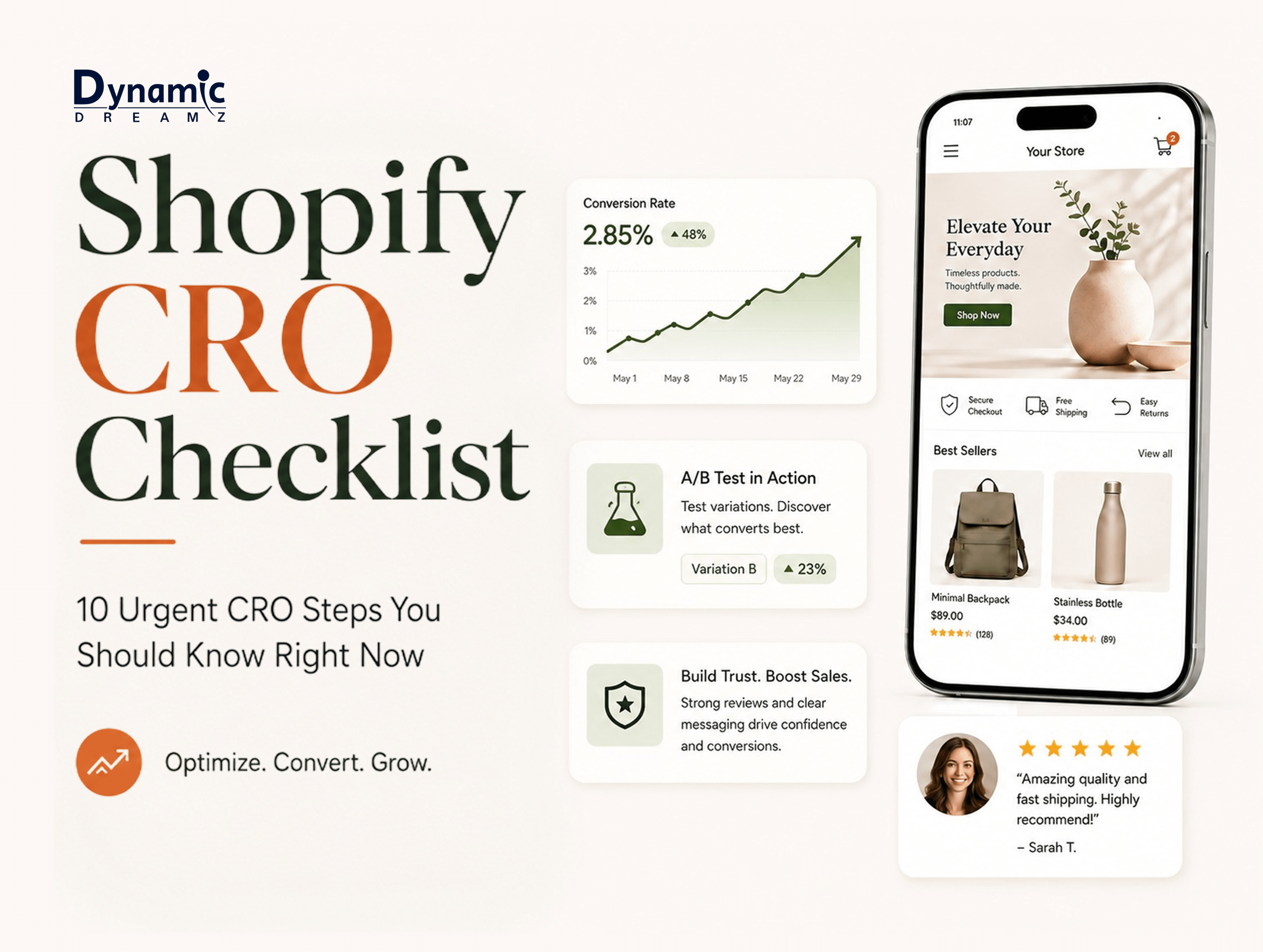
Shopify CRO Checklist: 10 Urgent CRO Steps You Should Know Right Now
The average Shopify store converts at just 1.4%. Top-performing stores hit 4–6%+. The difference is not traffic; it is optimization.
Most store owners pour money into ads trying to solve a revenue problem that is actually a conversion problem. More traffic into a leaking store just means more wasted ad spend. That is exactly where a Shopify CRO checklist changes everything.
Shopify conversion rate optimization CRO is the process of turning the visitors you already have into more paying customers. It is the highest-ROI activity available to any Shopify store owner because every improvement compounds directly into revenue without spending an extra rupee on acquisition.
This eCommerce conversion optimization checklist covers 10 urgent steps from auditing your funnel to running A/B tests that every Shopify store needs to implement right now.
What Is Shopify CRO and Why Does It Matter?
Shopify CRO strategy is the systematic process of improving the percentage of store visitors who complete a purchase. It is not about design preferences or gut instincts it is about using data, testing, and proven tactics to remove every obstacle between a visitor and a sale.
Here is why it matters more than any other growth lever available to Shopify store owners:
- Doubles revenue without doubling ad spend: Improving your conversion rate from 1.4% to 2.8% generates twice the revenue from the same traffic, with no additional acquisition cost.
- Compounds over time: Each CRO improvement builds on the last. A faster store + better product pages + streamlined checkout = conversion rate improvements that stack.
- Protects your ad ROI: Every ₹1 you spend on ads performs better when your store converts well. CRO is what makes paid traffic profitable.
Here is your complete Shopify store optimization checklist at a glance:
| Step | Focus Area | Primary Goal |
| 1 | Audit Your Conversion Funnel | Find where traffic leaks |
| 2 | Optimize Product Pages | Convert browsers into buyers |
| 3 | Strengthen CTAs | Drive clicks and action |
| 4 | Optimize for Mobile | Close the mobile conversion gap |
| 5 | Improve Site Speed | Stop losing 7% per second of delay |
| 6 | Build Social Proof | Eliminate purchase hesitation |
| 7 | Streamline Checkout | Reduce 69.8% cart abandonment |
| 8 | Eliminate Surprise Fees | Remove last-minute exit triggers |
| 9 | Personalize the Experience | Increase AOV and repeat purchases |
| 10 | Run A/B Tests Continuously | Compound improvements over time |
Step 1: Audit Your Conversion Funnel
Before fixing anything, you need to know where your store is leaking revenue. The funnel audit is the first step of every Shopify CRO checklist and the most important one. Fix the biggest leak first.
How to improve Shopify conversion rate starts with data, not assumptions. Use Shopify Analytics + Google Analytics 4 to map exactly where visitors drop off:
- Which pages have the highest exit rates?
- Which traffic sources convert best and which waste your budget?
- Where in the checkout flow are most abandonments happening?
- Which products get the most views but the fewest add-to-carts?
If your audit shows a 70% drop-off at checkout, fix checkout first, not your homepage hero image. If most exits happen on product pages, that is where your Shopify CRO strategy starts. Let the data lead, not instinct.
Step 2: Optimize Your Product Pages
Shopify product page optimization is where most conversion gains are won or lost. Your product page is your sales pitch; every element either builds confidence toward a purchase or introduces doubt.
Here are the Shopify store conversion tips that move the needle most on product pages:
- Hero image quality: Clean background, multiple angles, zoom capability, and lifestyle shots showing the product in use. Poor images kill trust instantly.
- Key information above the fold: Price, shipping cost, return policy, and delivery estimate must be visible without scrolling. Visitors who have to hunt for this information leave.
- Social proof placement: Star rating and review count directly below the product title, not buried at the bottom of the page.
- Sticky Add to Cart button: As visitors scroll down a long product page, the CTA should follow them. On mobile, this is non-negotiable.
- Unique product descriptions: Write benefit-focused copy that answers the customer’s real question, ‘What does this do for me?’ not just a list of specs.
Step 3: Strengthen Your CTAs
Your CTA is the single most tested element in eCommerce CRO and for good reason. A weak CTA on a great product page still loses the sale. To increase Shopify conversions, every CTA must be impossible to miss and impossible to resist.
- Button text: Test ‘Add to Cart’ vs ‘Buy Now’ vs ‘Get Yours Today’. Action-oriented, benefit-driven text consistently outperforms generic labels.
- Button color: High contrast against your background never blends in. If your store is white, your CTA button should not be light grey.
- Placement: Above the fold, sticky on scroll, and repeated below long product descriptions. Never make a visitor scroll back up to buy.
- Single primary goal: Each page should have one primary CTA. Too many competing buttons create decision fatigue and reduce conversions.
- Urgency triggers: ‘Only 3 left in stock’, ‘Sale ends tonight’, ‘Order in the next 2 hours for same-day dispatch’ genuine urgency drives immediate action.
Step 4: Optimize for Mobile Shoppers
Over 70% of Shopify traffic comes from mobile, but mobile converts at just 1% compared to desktop’s 2.3%. Closing this gap is one of the highest-impact moves in any Shopify mobile optimization strategy.
Mobile optimization is not just about making your desktop site smaller. It requires rethinking the entire experience for a thumb-driven, small-screen context:
- All text legible without pinch-zooming
- Images scale cleanly across all screen sizes
- Form fields large enough to tap accurately
- CTA buttons sized and positioned for thumb reach bottom half of screen
- No intrusive popups blocking content on mobile
- Navigation streamlined, fewer taps to reach product pages
Always test on real devices; browser emulation misses real-world performance issues that real customers encounter on their actual phones.
Step 5: Improve Site Speed
Every 1-second delay in page load time reduces conversions by 7%. A store that loads in 4 seconds is losing more than 20% of potential conversions before a single visitor reads your value proposition.
Site speed is a critical pillar of Shopify conversion rate optimization and one where small fixes deliver outsized results. Here is what to prioritize:
- Image optimization: Compress all images and convert to WebP format. Product images are typically the largest files on any Shopify store.
- App audit: Every installed Shopify app adds JavaScript to your storefront. Remove any app that does not directly and measurably contribute to revenue.
- Defer non-critical scripts: Chat widgets, review carousels, and email capture tools do not need to load the moment your page renders. Delay them.
- Lightweight theme: Multipurpose themes packed with 100+ features you never use slow every page. Choose a fast, minimal theme like Dawn or Ride.
- Core Web Vitals targets: LCP under 2.5 seconds, INP under 200ms, CLS under 0.1. These are Google’s benchmarks for a fast, stable store.
If your store needs a full speed audit and technical optimization, the Shopify development team at Dynamic Dreamz has optimized stores across 20+ countries for performance that directly impacts conversion rates.
Step 6: Build Trust With Social Proof
Purchase hesitation is the invisible conversion killer. Visitors who are interested in your product but uncertain about quality, delivery, or returns abandon and never come back. Social proof is what overcomes that hesitation.
For a strong eCommerce CRO checklist, here is how to build trust at every stage of the customer journey:
- Star ratings and reviews: Visible on product pages, collection pages, and homepage. Never hide reviews at the bottom of the page.
- Video testimonials and UGC: Real customers using your product in real life convert better than any professional photography.
- Trust badges: SSL certificate, secure checkout icons, payment method logos, and money-back guarantee seals especially near the Add to Cart button.
- FAQ sections on product pages: Address the top 5 objections before the customer thinks of them: shipping time, return policy, sizing, compatibility, warranty.
- Weave proof throughout: Don’t dump all social proof in a footer widget. Integrate reviews and UGC into content blocks across your homepage, product pages, and cart; this is what separates average stores from high-converting ones.
Step 7: Streamline Your Checkout Flow
Cart abandonment averages 69.8% across all Shopify stores. The checkout flow is where most revenue is lost and where the biggest CRO gains are available.
Every unnecessary step, form field, or friction point in your checkout is a Shopify checkout optimization opportunity and a reduced cart abandonment Shopify fix waiting to happen:
- Single-page checkout: Fewer steps mean fewer abandonment opportunities. Shopify’s native one-page checkout is a conversion improvement most stores should enable immediately.
- Guest checkout: Never force account creation before purchase. Mandatory accounts are one of the top reasons customers abandon at checkout.
- Minimize form fields: Only collect what you absolutely need to process the order. Every additional field is a drop-off risk.
- Accelerated payments: Enable Shop Pay, Apple Pay, and Google Pay. These allow mobile shoppers to complete purchases in a single tap, dramatically reducing checkout friction.
- Abandoned cart recovery: Set up automated email and SMS sequences that trigger within 1 hour of abandonment. Top-performing stores recover 15–25% of abandoned carts through automation.
Step 8: Eliminate Surprise Fees
Surprise fees revealed at checkout are the #1 cause of cart abandonment on Shopify stores. A customer who has decided to buy and then discovers an unexpected ₹150 shipping fee at the final step feels deceived and leaves.
This is both a Shopify cart abandonment fix and a Shopify checkout optimization improvement that costs nothing to implement:
- Show shipping costs early: Display shipping fees or free shipping eligibility on product pages and in the cart before the customer enters checkout.
- Free shipping threshold strategy: A clearly communicated free shipping threshold (‘Free shipping on orders over ₹999’) increases average order value AND eliminates the shipping fee surprise.
- Transparent tax display: Show estimated taxes before checkout where possible. Surprise tax amounts at the final step cause abandonment just as much as shipping fees.
- Delivery estimates: Show realistic delivery dates on product pages and cart, not just ‘Ships in 3–7 days’. Specific dates build confidence and reduce hesitation.
Step 9: Personalize the Shopping Experience
Personalization transforms a generic store into one that feels like it was built for each individual visitor. For eCommerce CRO checklist purposes, personalization is not just ‘Recommended for You ‘; it is a full strategy to increase Shopify conversions by showing the right product to the right visitor at the right moment.
- Cross-selling: Show complementary products on product pages and in the cart: ‘Customers also bought’, ‘Complete the look’, ‘Pairs well with’. This increases AOV without additional traffic.
- Upselling: On product pages, offer a premium version, larger size, or bundle that delivers more value. Frame it as an upgrade, not an add-on.
- Recently viewed: Show visitors the products they browsed earlier. Simple to implement via Shopify apps, high conversion impact for returning visitors.
- Back-in-stock alerts: Capture demand for out-of-stock products with email and SMS alerts. These visitors have already decided to buy just give them the chance.
- New vs returning visitor offers: Show first-time visitors a welcome discount. Show returning visitors products related to their last browse. Segmentation makes personalization scalable.
Step 10: Run A/B Tests Continuously
Shopify A/B Testing is the 10th step and the reason this checklist never truly ends. CRO is not a one-time project. It is an ongoing process of testing, learning, and compounding improvements over time.
Every assumption you have about your store which CTA text converts best, which product image performs better, which price display drives more purchases can be tested. How to improve Shopify conversion rate consistently comes down to building a testing culture:
- Start with highest-traffic pages: Test where the most visitors are on your top product pages and homepage. Small percentage improvements on high-traffic pages deliver the biggest absolute revenue gains.
- One variable at a time: Change one element per test headline, image, CTA text, or button color. Multiple simultaneous changes make it impossible to identify what moved the needle.
- Run for minimum 2 weeks: Traffic fluctuates day to day and week to week. Never declare a winner based on a few days of data early results are almost always misleading.
- Build a test archive: Document every test hypothesis, what was tested, the result, and what was learned. Losers teach just as much as winners. Your archive becomes your most valuable CRO asset over time.
For a detailed guide on setting up and running A/B tests on your Shopify store, read our complete A/B Testing guide covering tools, step-by-step setup, and best practices.
Final Thoughts
Shopify CRO is not a one-time fix it is the most reliable, highest-ROI growth strategy available to any store owner. Every step in this checklist compounds on the others: a faster store converts more mobile visitors, better social proof makes your checkout changes more effective, and A/B testing keeps improving everything over time.
Start with the audit. Find your biggest leak. Fix it. Then move to the next step.
The stores winning in 2026 are not the ones with the biggest ad budgets. They are the ones with the best-optimized funnels, and this checklist is your blueprint to build one.
At Dynamic Dreamz, our Shopify experts have helped 1,000+ store owners audit, optimize, and scale their stores. From full CRO audits to complete Shopify store builds engineered for conversion from day one, we are here when you are ready to grow.
FAQ
What is a Shopify CRO checklist?
A Shopify CRO checklist is a structured framework of conversion rate optimization steps that store owners follow to systematically improve the percentage of visitors who complete a purchase. It covers every stage of the customer journey from product pages and mobile experience to checkout flow and post-visit recovery, giving store owners a clear, actionable roadmap to increase revenue from existing traffic.
What is a good conversion rate for a Shopify store?
The average Shopify store converts at 1.4–3.2%, depending on the industry. Top-performing stores consistently achieve 4–6% or higher through strategic CRO. A good benchmark to target is 3%+ which puts you well above average.
If your store is below 1.4%, addressing the foundational steps in this checklist speed, mobile optimization, and checkout friction typically delivers the fastest improvement.
How do I improve my Shopify store’s conversion rate?
Start with a conversion funnel audit to identify where visitors are dropping off. Then prioritize fixes based on impact: checkout friction, site speed, and mobile optimization typically deliver the fastest gains.
Optimize product pages for clarity, strengthen CTAs, build trust with social proof, and eliminate surprise fees at checkout. Run A/B tests on your highest-traffic pages to continuously improve results based on real data.
What is the most common cause of cart abandonment on Shopify?
Surprise fees revealed at checkout unexpected shipping costs, taxes, or handling fees are the most common cause of cart abandonment on Shopify stores. Other major causes include mandatory account creation, too many checkout steps, limited payment options, and lack of trust signals at the checkout stage.
The fixes are straightforward: show all costs upfront, enable guest checkout, minimize form fields, and add accelerated payment options like Shop Pay and Apple Pay.
How does A/B testing help with Shopify CRO?
A/B testing removes guesswork from Shopify CRO by letting real visitor behavior determine which changes actually improve conversions. Instead of assuming a new CTA button color will work better, you test both versions simultaneously and let the data decide.
Over time, a consistent A/B testing practice compounds; each winning test builds on the last, steadily moving your conversion rate upward in a way that no single one-time redesign can match.
How long does it take to see results from Shopify CRO?
Some CRO fixes like enabling guest checkout, eliminating surprise fees, or activating accelerated payments can show measurable conversion improvements within days. Others, like A/B testing and content optimization, require 2–4 weeks of data to produce statistically significant results.
Meaningful overall conversion rate improvement typically becomes visible within 30–60 days of systematic implementation. CRO is a compounding strategy results build over time as each improvement stacks on the last.